30/10/2026
Is the Gold Coast property market crashing? What falling prices and rising building costs mean for buyers


SIERA Perspectives | By Brent Thompson, Founder and Managing Director, SIERA
As at 30 October 2026
Established home prices have corrected from a record peak across the country and on the Gold Coast, while the cost of building a new home is still rising. Both can be true at once, because established resales and new homes are priced in different ways. As a builder-developer working across both the Gold Coast and Brisbane, designing, building, selling, and managing our own residences, we like to think we have a pretty good grasp on market conditions. We put a lot of time into research and analysis of the market on a macro and a micro level. Although we do not make price forecasts, we think through the fundamentals, current sentiment, and the wider situation, then make our best guess about the future. That work guides our own business strategy, which must stay aligned with what is right for our buyers if we are to continue to sell and deliver projects successfully.
Is the Gold Coast property market crashing?
No, we have seen established prices correct from what has been a record peak, which is expected and typical of property market cycles. Over the history of property and markets in general, prices have peaked, come off the peak, stabilised for a period, and then typically continued to grow.
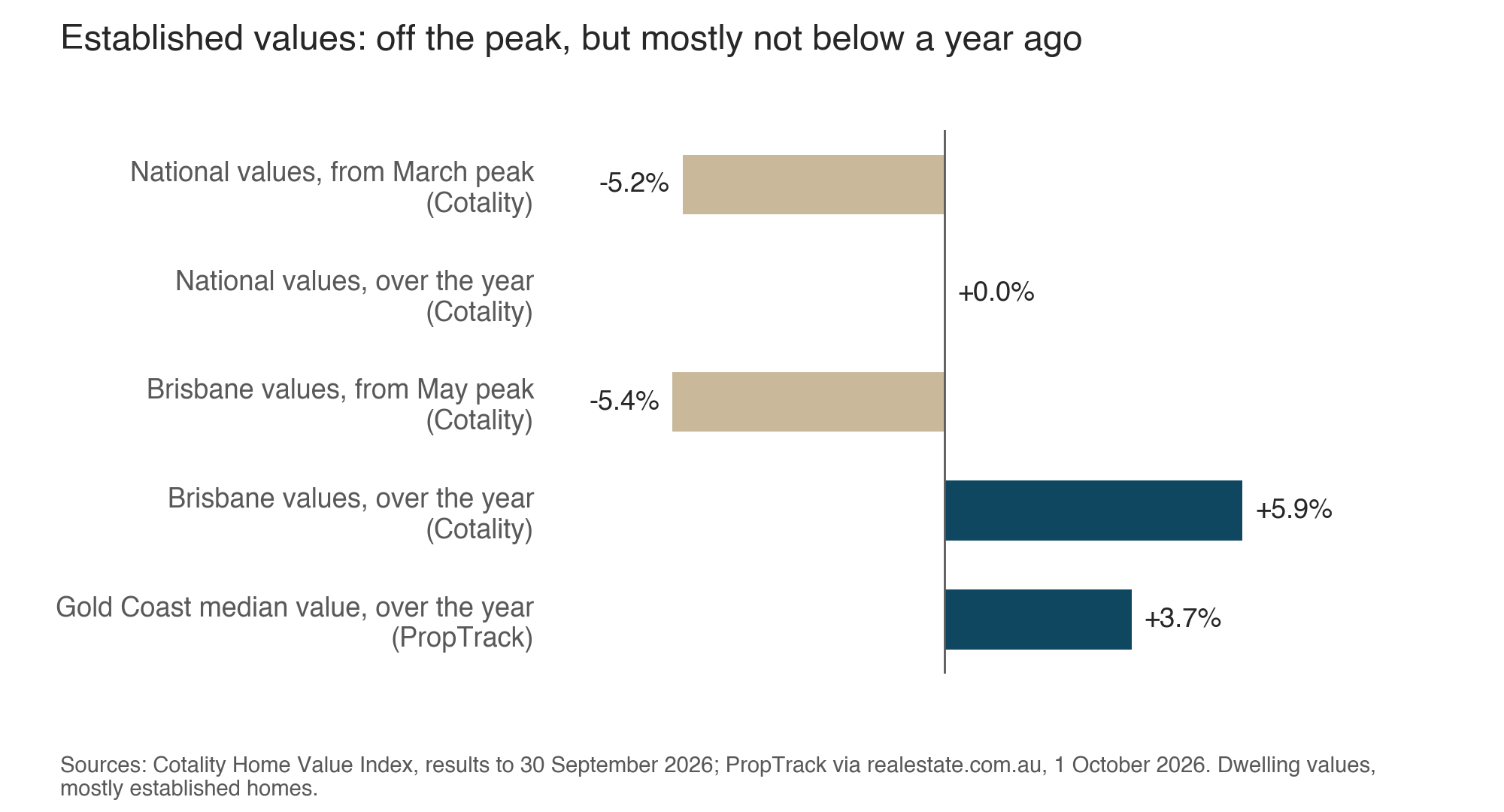
We are seeing this correction in established homes across the country. Cotality's Home Value Index for September 2026 shows national established dwelling values sit 5.2% below their March 2026 record high. In Brisbane, Cotality records that established dwelling values are 5.4% below their May 2026 peak. Even so, Cotality's index shows Brisbane established dwelling values remain 5.9% higher than a year earlier.


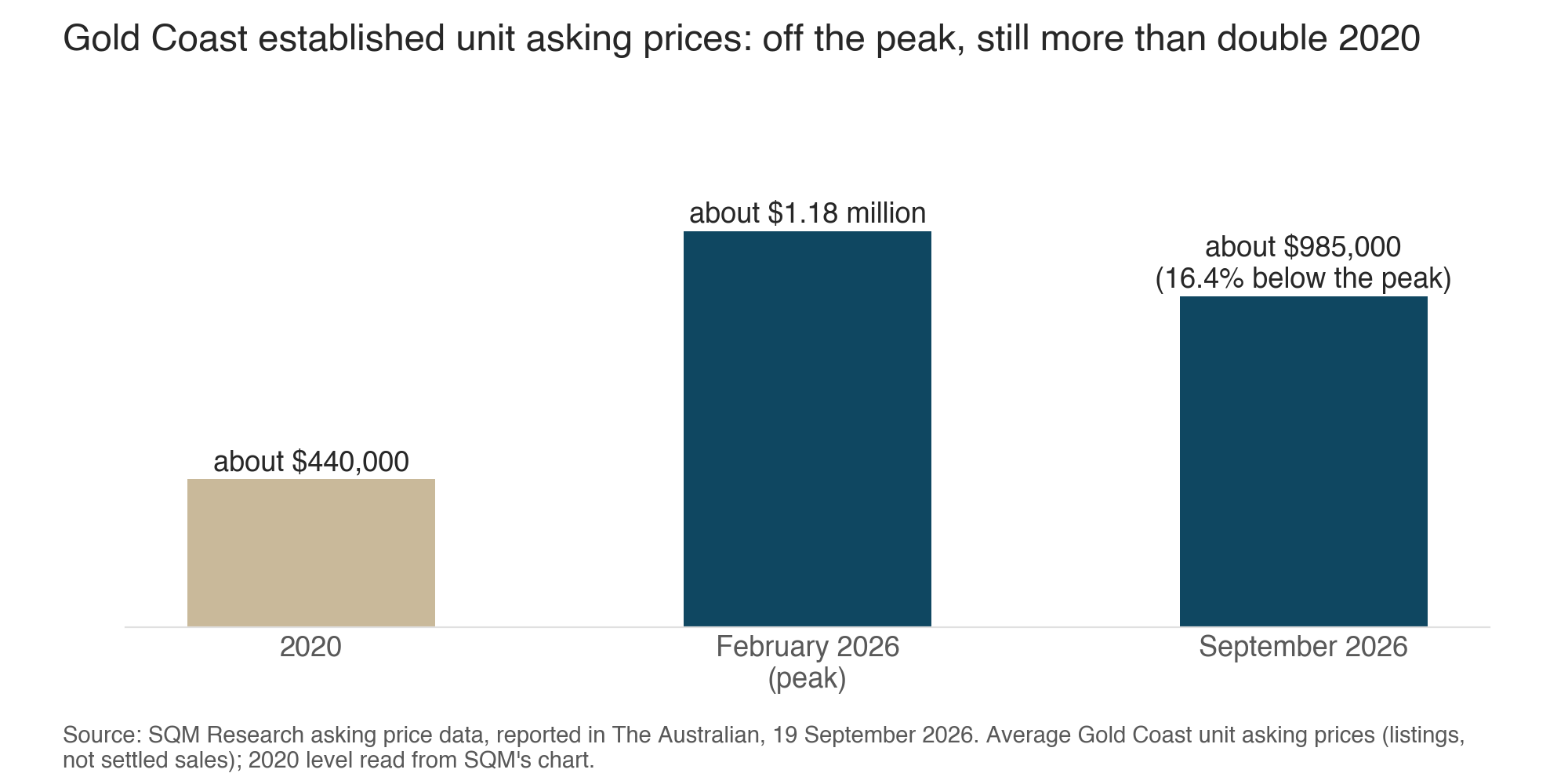
On the Gold Coast, the biggest headline drops measure what sellers of established homes are asking on listings, not settled sales. SQM Research asking price data, reported by Mackenzie Scott in The Australian in September 2026, shows the average Gold Coast established unit asking price fell 16.4% from its February 2026 peak. SQM Research's chart also shows those Gold Coast established unit asking prices are still more than double their 2020 level.


Settled resale values tell a steadier story. PropTrack data published by realestate.com.au in October 2026 shows the Gold Coast median established dwelling value remained 3.7% higher than a year earlier. What we are seeing is some price correction and stabilisation from what has been a record peak, as I explained in Will Gold Coast and Brisbane apartment prices fall? How we see the market in late 2026.
Are new and off-the-plan homes falling too?
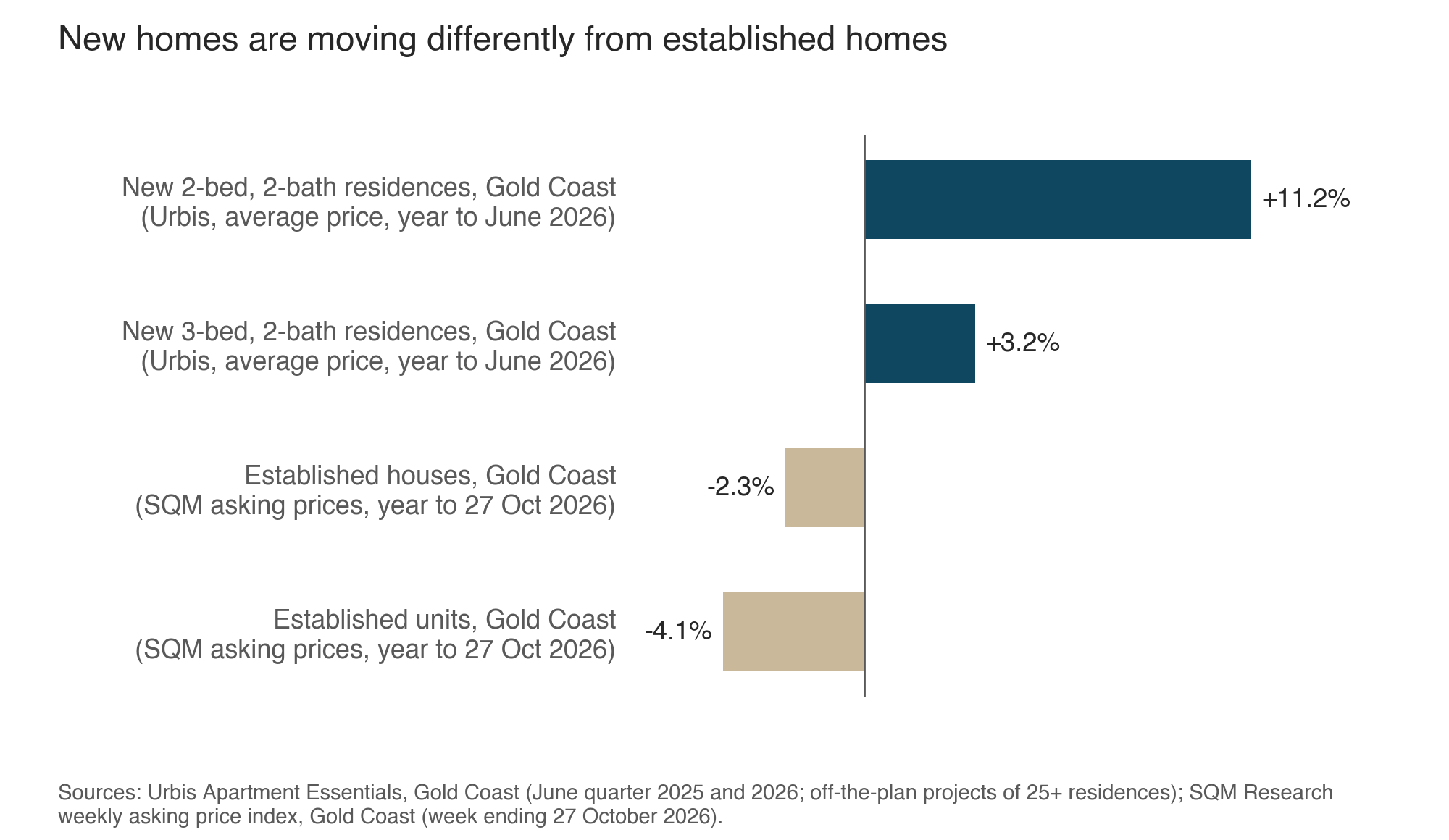
Not on the evidence we have. Urbis's survey of new Gold Coast apartments sold off the plan shows the most common new home, a two-bedroom, two-bathroom residence, rose about 11% in average price over the year to June 2026, while established asking prices fell.
In that same June 2026 survey, Urbis found new Gold Coast three-bedroom, two-bathroom residences rose about 3% in average price over the year. For those new three-bedroom homes, Urbis recorded the average price per square metre rising about 8%. Across all new Gold Coast apartment types, Urbis recorded the moving annual average price per square metre rising about 4%.


The Gold Coast is many markets, not one. The City of Gold Coast's May 2025 State of the City report notes the city spans about 57 kilometres of coastline and more than 30 beaches. The northern canal and golf estates around Hope Island, the high-rise centre around Surfers Paradise, and southern beach suburbs such as Kirra are different markets with different buyers and stock. Urbis reflects this by dividing the new Gold Coast apartment market into four precincts: North Shore, Gold Coast Central, Coastal Fringe, and Southern Beaches.
Established prices also vary by place and type. PropTrack suburb data published by realestate.com.au on 9 October 2026 shows Broadbeach established unit values fell 8% over the September quarter. PropTrack's data also shows Hope Island established unit values fell 7% over that quarter.
Across the city, SQM Research's weekly asking price index for the week ending 27 October 2026 shows Gold Coast established unit asking prices were 4.1% lower than a year earlier. In that same SQM Research index, Gold Coast established house asking prices were 2.3% lower over the year. SQM Research shows Gold Coast established three-bedroom house asking prices were almost flat, down 0.3% over the year.
No published data splits Gold Coast prices by building age, so these established figures combine homes of different ages.
Will house prices drop in 2027?
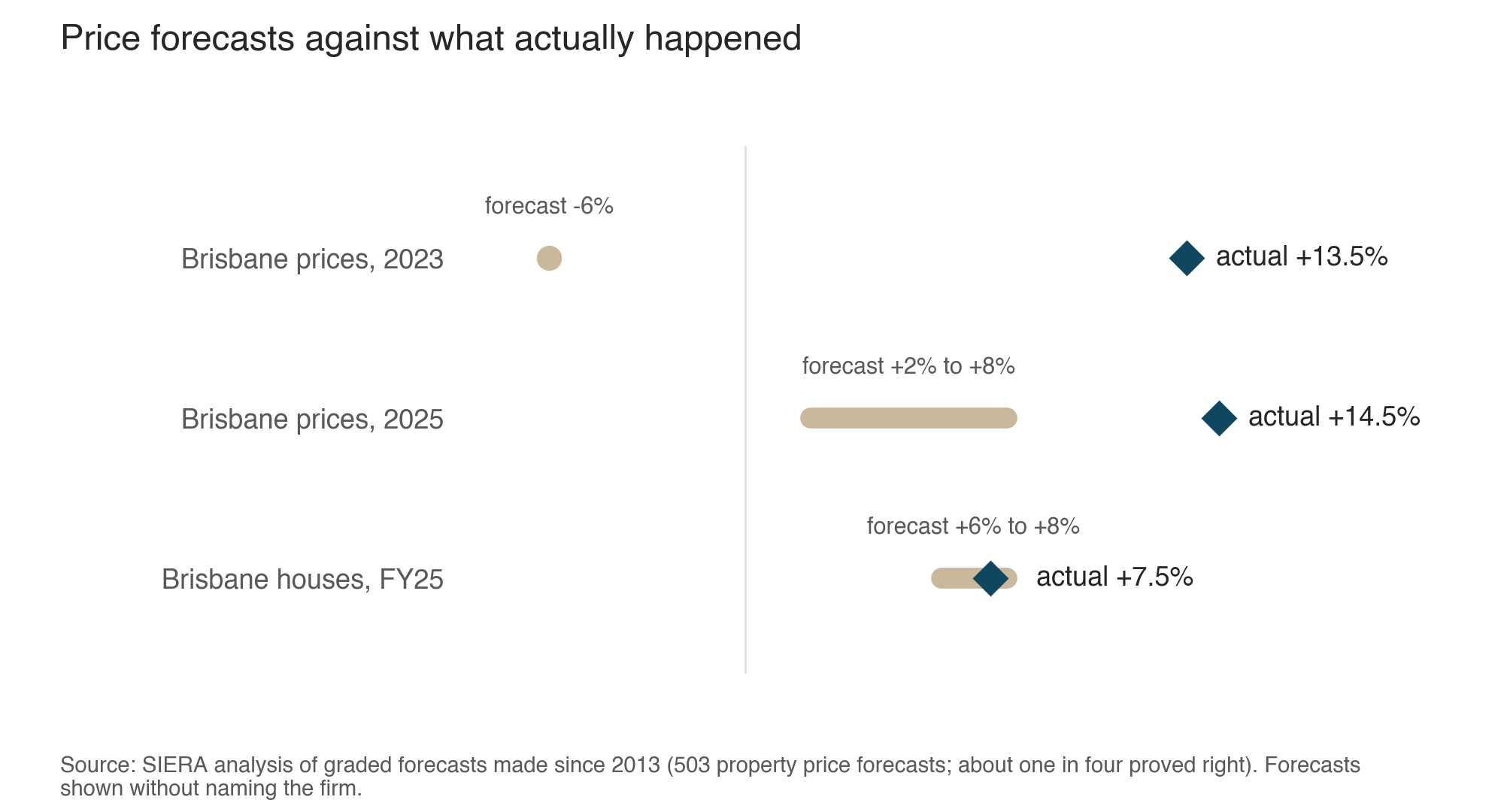
No one can say for certain. SIERA runs its own research division with ongoing analysis of the market, and our analysis of 503 graded property price forecasts made since 2013 found about one in four proved right.
For 2025, the published forecasts for established Brisbane prices that SIERA scored ranged from about 2% to 8% growth. SIERA's analysis shows established Brisbane dwelling values actually rose about 14.5% in 2025.
In SIERA's scored record, a November 2022 forecast expected established Brisbane prices to fall 6% in 2023. SIERA's analysis shows established values rose about 13.5% instead. Some prove right: a June 2024 forecast of 6% to 8% growth for established Brisbane house prices in the 2025 financial year came in at 7.5% in SIERA's analysis.

Today's forecasts for established Gold Coast prices also vary. In The Australian in September 2026, SQM Research's Louis Christopher said Gold Coast prices were on track for a total fall of about 20%. Ray White's Andrew Bell said in September 2026 that established Gold Coast prices may give back around 5% to 10% from the peak over 12 to 18 months before a flat market. Also in The Australian in September 2026, realestate.com.au economist Luc Redman said established Gold Coast price softening was unlikely to be prolonged or deep, given population growth and a strong local economy.
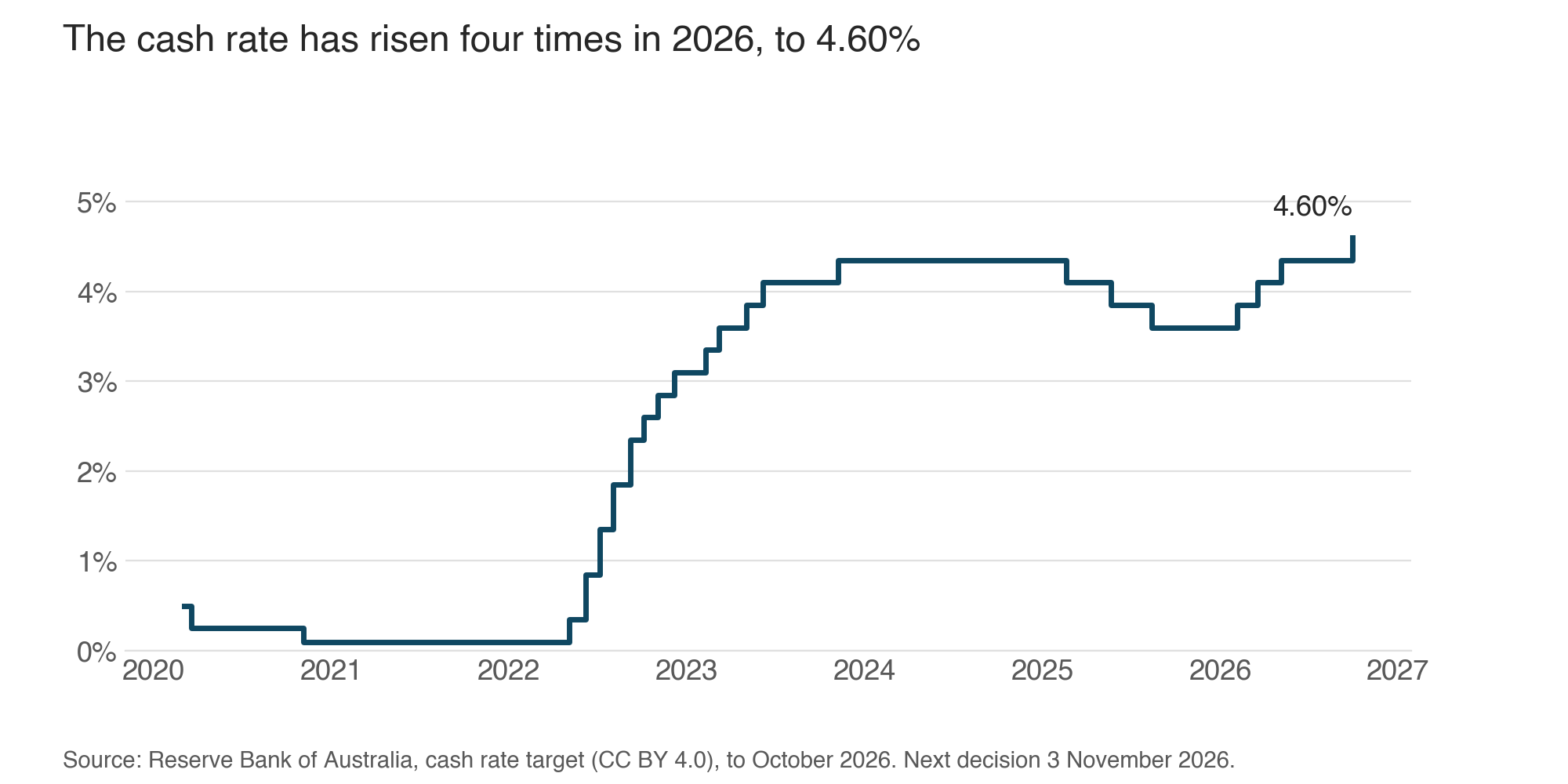
The Reserve Bank of Australia lifted the cash rate to 4.60% on 30 September 2026, its fourth rise of 2026, and meets again on 3 November 2026. Federal tax law passed in June 2026 limits negative gearing to new homes from 1 July 2027, with properties already held grandfathered. We would love to share more of this research with anyone who wants to know more.

If prices are falling, why won't new homes get cheaper?
A new home's price is set by what it costs to create, as long as there is demand for it. If there is no demand at that cost, new homes simply stop being built.
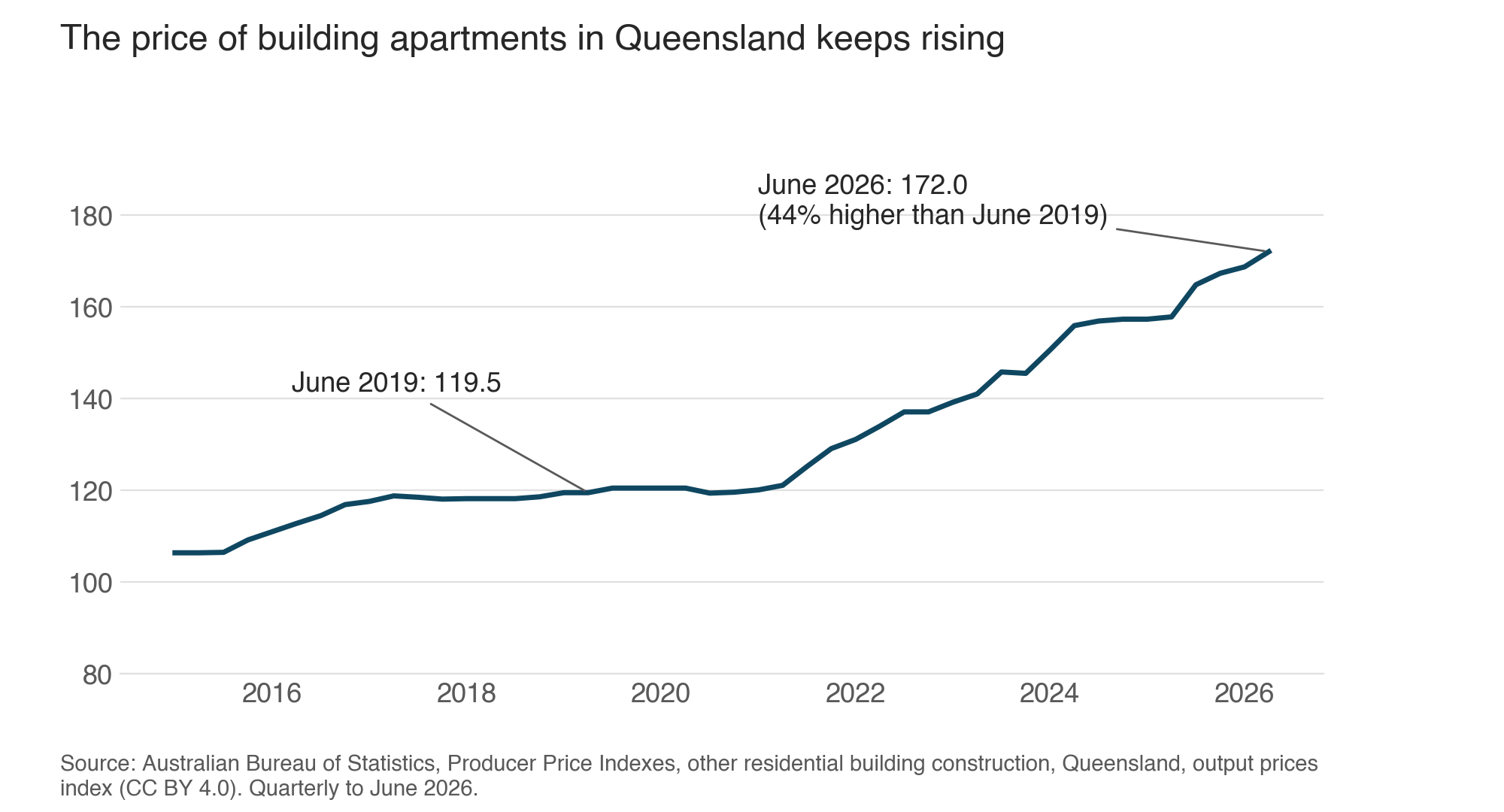
ABS Producer Price Indexes for the June quarter of 2026 show output prices for building apartments in Queensland rose 9.0% over the year. Rider Levett Bucknall's September 2026 Construction Market Update forecasts Gold Coast tender prices to rise 5.5% in 2026, then 7% a year from 2027 to 2029. The Urban Developer and WT's September 2026 Industry Sentiment Survey found labour has overtaken materials as the leading cost pressure for the first time. On the land side, the Oliver Hume Median Lot Price report (realestate.com.au, October 2026) showed the Gold Coast median residential lot price rose 25.6% over the year to $910,000, while cautioning that small volumes can drive large moves.

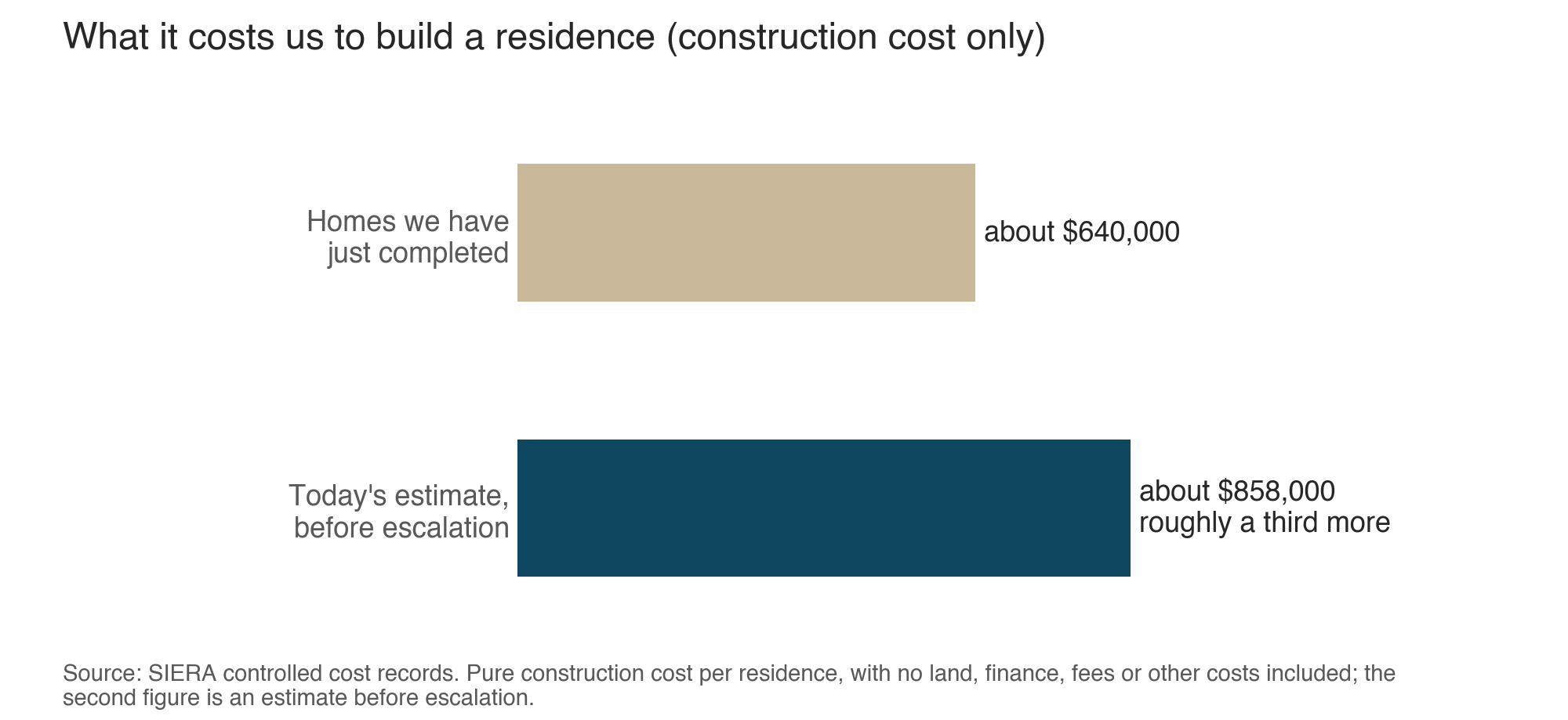
In our own records, build costs are still rising, with no softening. The residences we have just finished building cost about $640,000 each in pure construction cost, with nothing else taken into account. On today's estimate for our next building, before escalation, pure construction cost is about $858,000 each, roughly a third more, with no land, finance, fees, or other costs included. In our experience, where you need about $2 of sales revenue for every $1 of construction cost just to make a project feasible for someone to finance, every rise in construction cost has a major impact on the cost of delivery.


Periods of no new supply lead to an undersupply, which ultimately leads to a slingshot reaction, as we have seen in the past. The Property Council of Australia and Urbis reported in May 2026 that after new Gold Coast build-to-sell apartment completions peaked in 2018, unit and townhouse lot registrations ran at under half the regional plan target every year from 2020. SQM Research's September 2026 data shows Gold Coast established unit asking prices more than doubled from 2020 to their 2026 peak. Cotality's figures show Brisbane established dwelling values rose about 71% from trough to peak over five years.


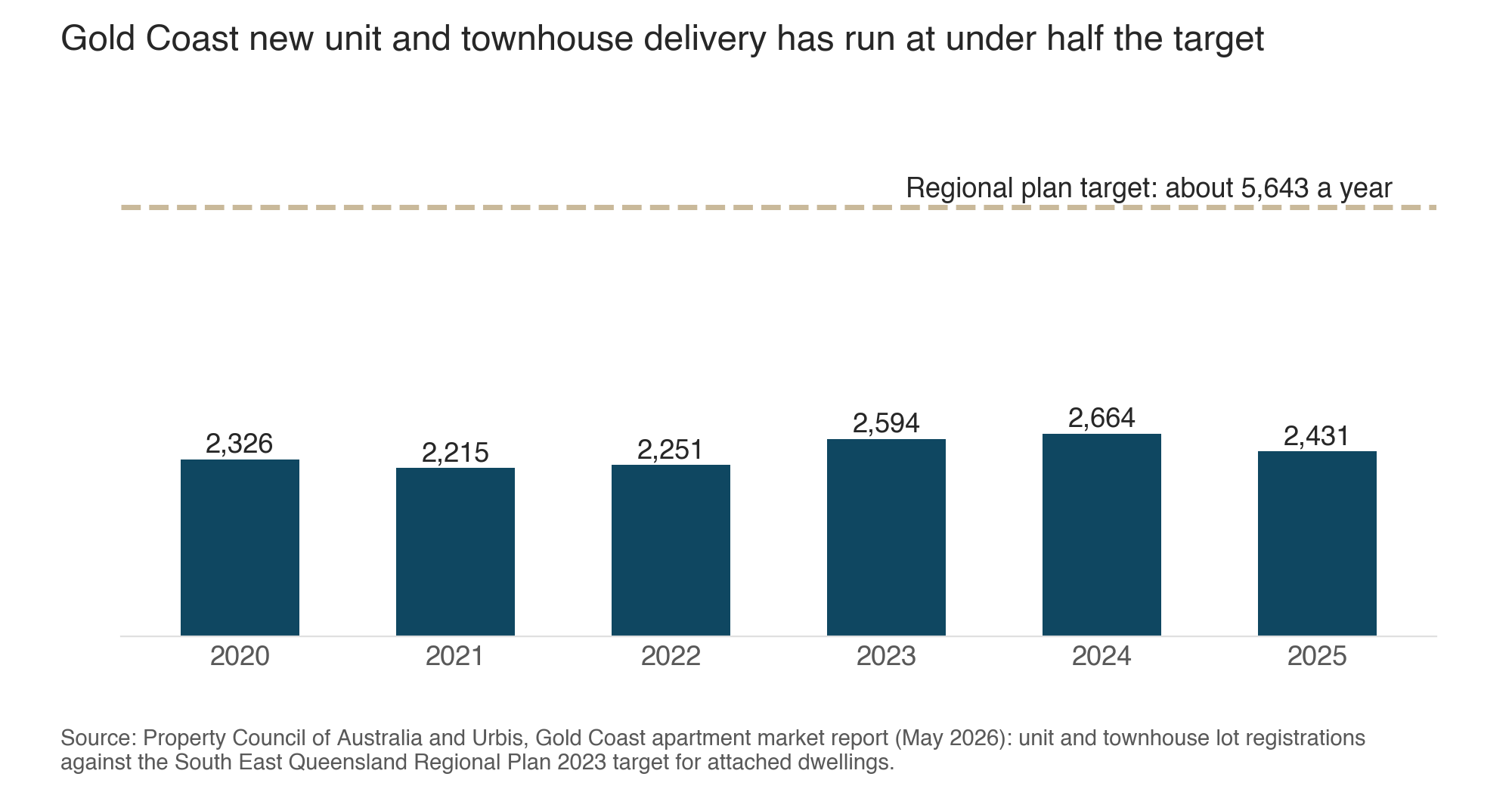
Once you turn the supply pipeline off, it does not turn back on quickly, because off-the-plan apartment projects take several years to plan, approve, and pre-sell, and several years to build. ABS data reported by The Good Builder in October 2026 puts the average time to build an apartment project at about 10 quarters, up from 7.3 quarters two years earlier. Reuters reported in August 2026 that 83% of Gold Coast apartments approved since 2020 are still under construction.
Typically we do not see construction prices come back down, which means the cost of delivery will remain elevated and continue to grow, meaning that the replacement value will be above the current value. The towers delivered through Main Beach and Broadbeach in the 1980s and 1990s could spread across landscaped grounds with tennis courts and large pools at ground level until the cost of land changed what could be provided at an attainable price, and construction cost is now applying the same pressure to the residences themselves.
Will fewer new homes be built on the Gold Coast?
Yes, over time. Most of the homes finishing now were pre-sold years ago, and few new projects can start without pre-sales at today's costs.
For a new apartment project to get started in construction, a lender generally needs pre-sales in place first. A lot of the projects being built now are already predominantly pre-sold, and Colliers noted in its March 2024 Gold Coast Residential Apartment Market Report that the bulk of completing new Gold Coast apartments had been pre-sold over several years and would not ease supply pressure.

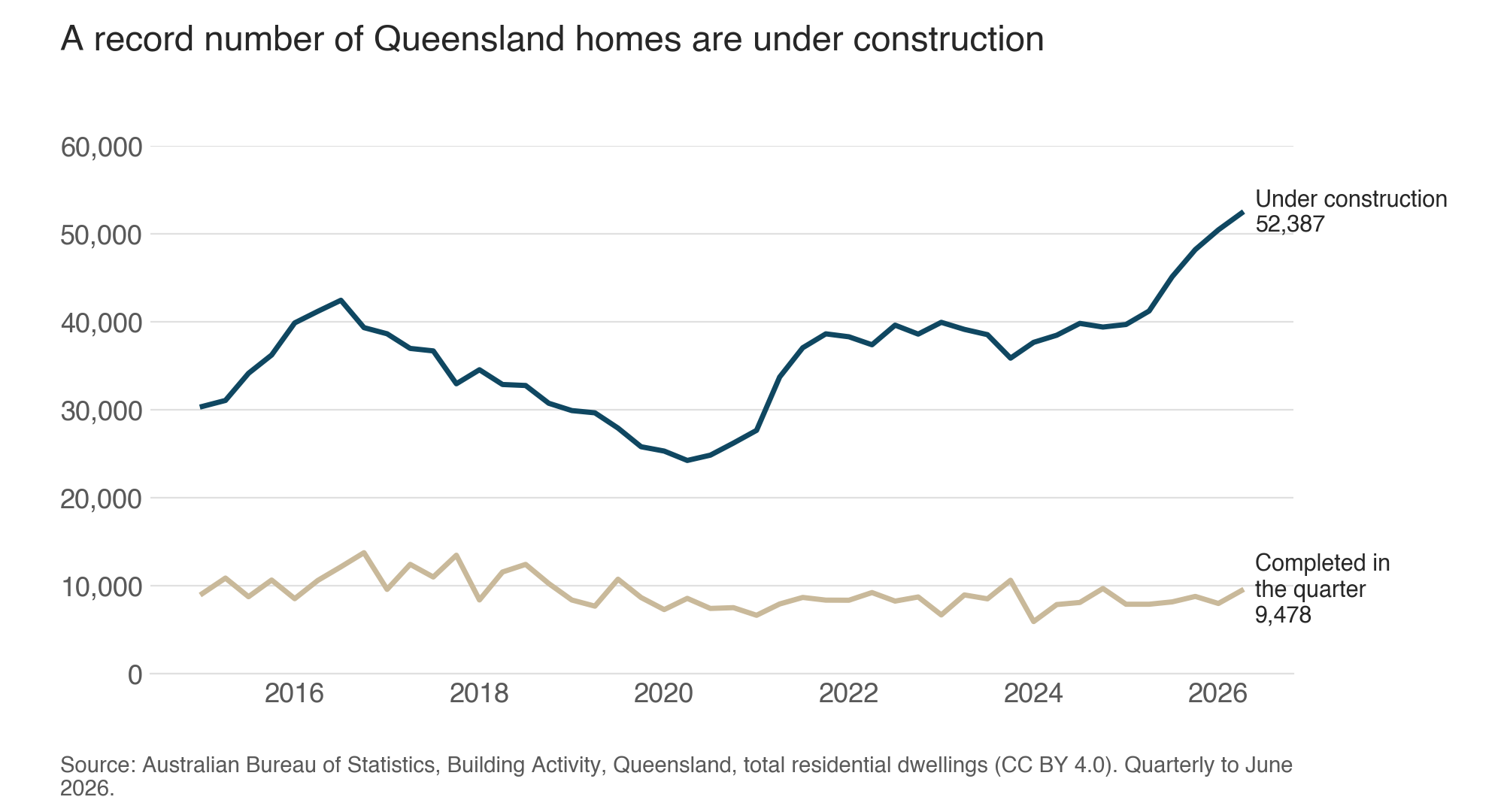
ABS Building Activity figures for the June quarter of 2026 show a record 52,387 new homes under construction across Queensland. The Property Council of Australia and Urbis reported in May 2026 that 2026 and 2027 are likely to be the peak completion years for new Gold Coast apartments.
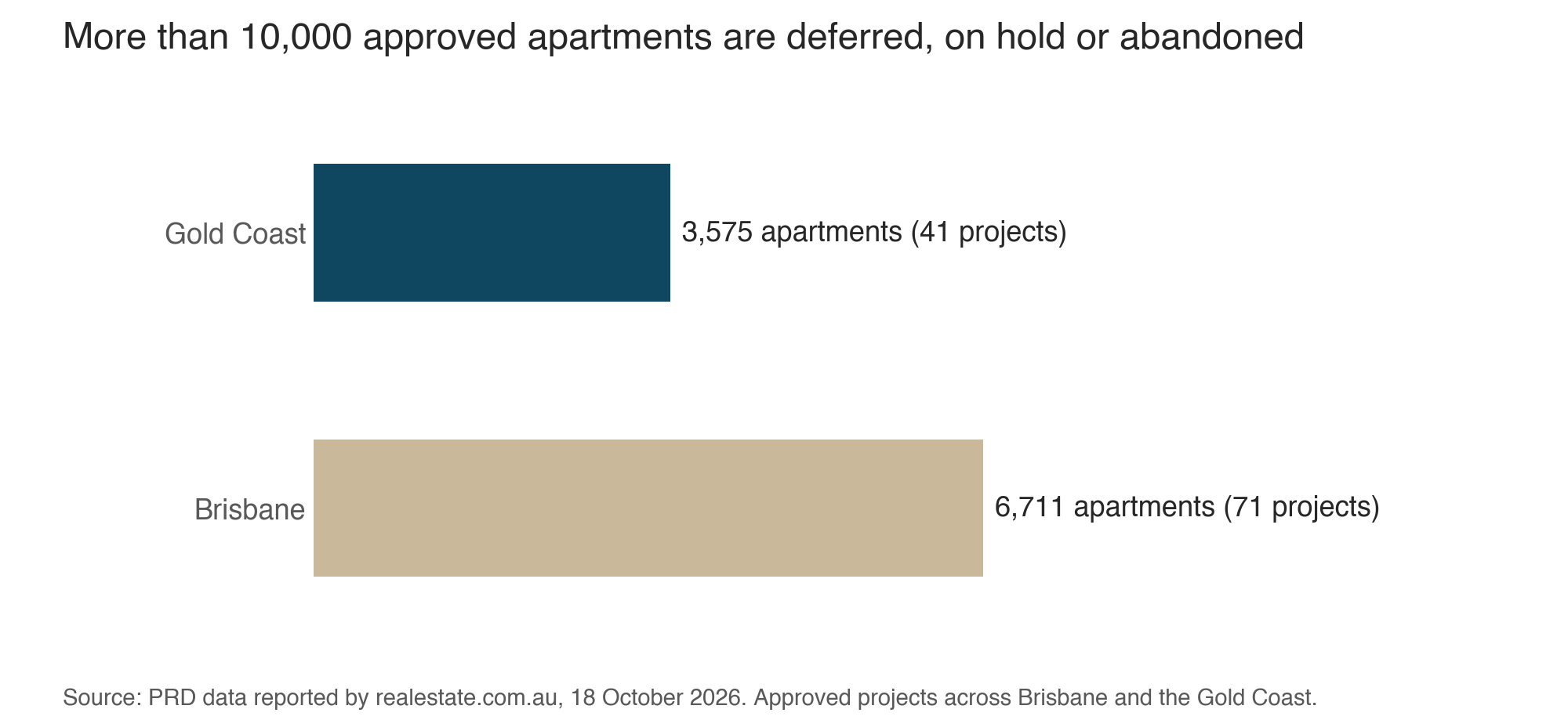
What comes after that wave is much smaller. PRD research reported by Elizabeth Tilley on realestate.com.au in October 2026 found 3,575 approved new Gold Coast apartments across 41 projects are deferred, on hold, or abandoned. If new projects are not coming through and it takes several years to get started, there is going to be a big hole in the delivery pipeline.

Things are getting harder to stack up. As the Property Council and Urbis noted in May 2026, recent Gold Coast new-apartment launches are carried by more expensive beachfront projects, because those are the ones developers can actually make feasible to deliver. We have a structural undersupply of housing and fewer projects are going to stack up. The ones that do get built will cost more.
Are the right homes being built for the people moving here?
Much of what is being launched sits at the top end of the market. People moving out of the family home, retiring, relocating, or investing have fewer well-located choices at a price they can afford.
Across different samples, realestate.com.au's May 2026 New Homes Insight Series found that only 12% of Queensland apartment buyers had budgets above $1.5 million. The same realestate.com.au series found 58% of new Queensland apartment listings were above $1.5 million.

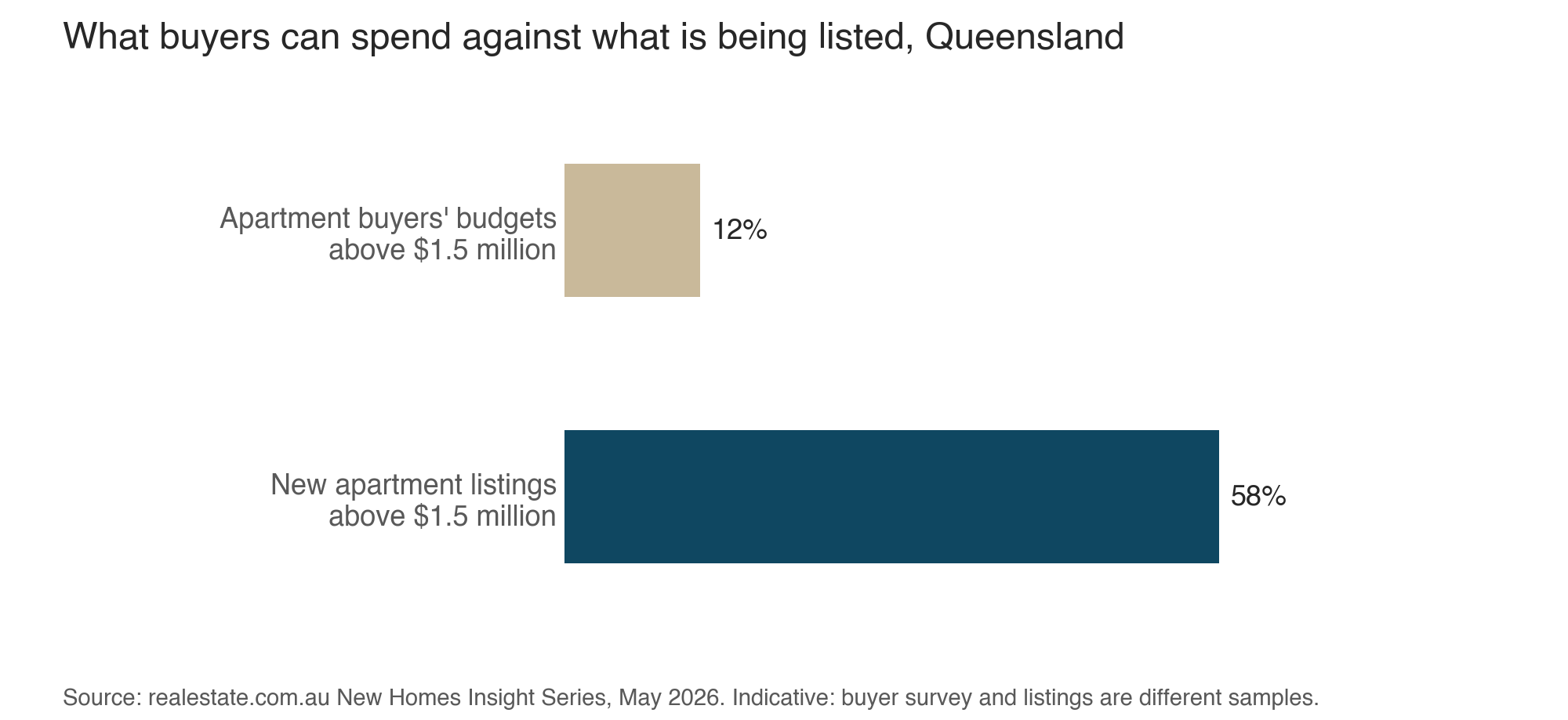
The comparison is indicative, and on the Gold Coast much of what is being delivered sits at the top end, leaving fewer new choices in the middle of the market and not always in the locations people want day to day.
The ABS recorded the Gold Coast's population at 691,230 at 30 June 2025. The City of Gold Coast expects the population to reach about one million within 20 years, the ABC reported in September 2026. The REIQ recorded the Gold Coast rental vacancy rate at 1.6% in the September 2026 quarter.

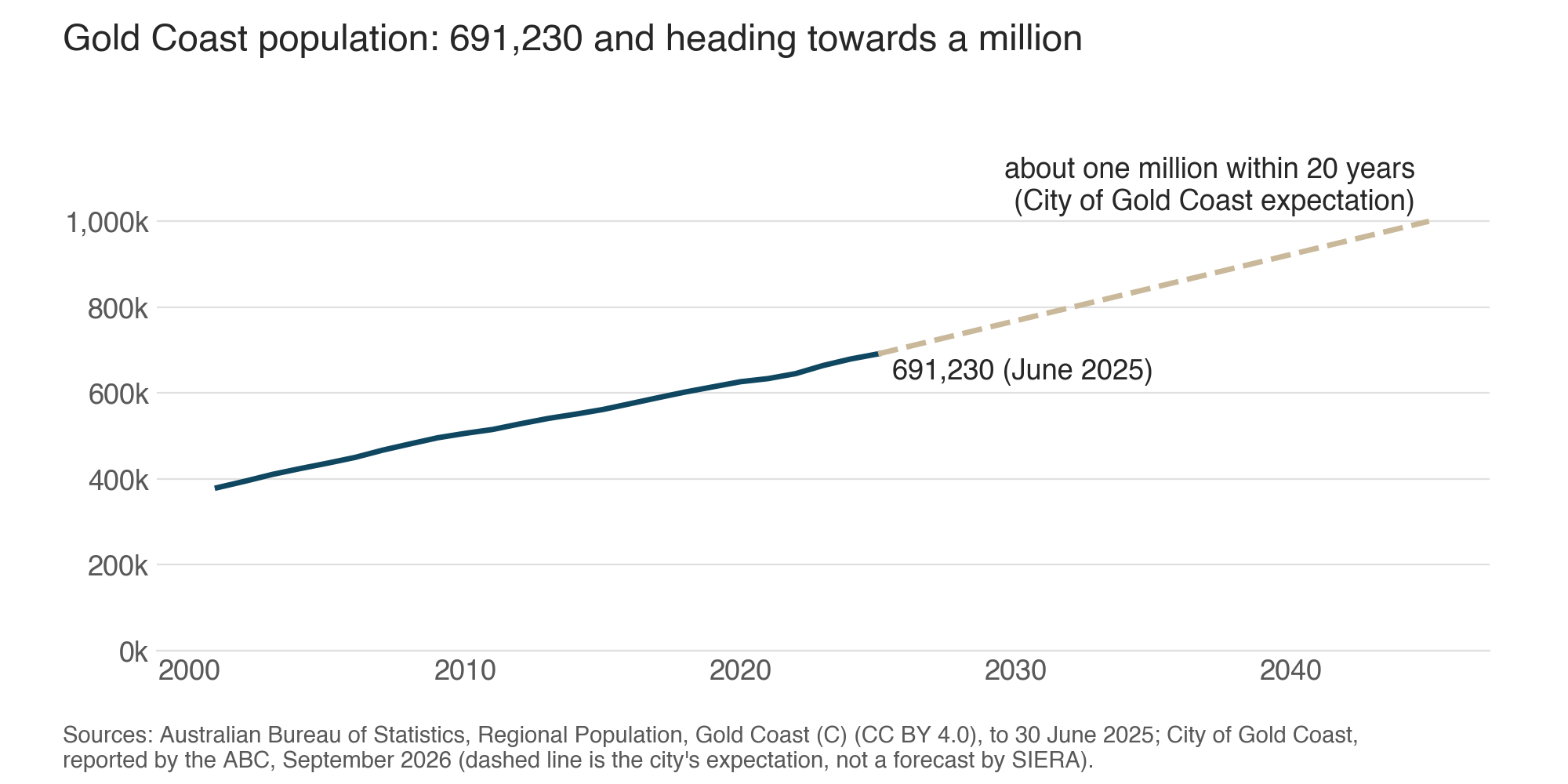
I think jobs, lifestyle, population growth, limited supply, and higher build costs mean higher prices over time, and not everyone who wants to move here will be able to.
Who is buying new homes right now, and why?
Mostly people choosing a lifestyle or a change, such as selling the family home, retiring, or relocating. Investors are a big part of new buying too.

The Property Council of Australia and Urbis reported in May 2026 that investors made up about two thirds of new Gold Coast apartment buyers in 2025. ABS Lending Indicators for the June quarter of 2026, reported by realestate.com.au in October 2026, show national investor loans for new homes reached a record 10,923, up 21.7% over the year. In the same ABS release, national investor loans for established homes fell 14.8% over the quarter, alongside the federal tax change favouring new homes from July 2027.
We saw buying interest slow after the May Budget and pick up in the last couple of weeks, with buyers committing through expressions of interest and contracts being issued. Some are business owners retiring, who see the media headlines as noise and want to secure the right home while there are still good choices available.
Others are repeat off-the-plan buyers staying focused on their long-term plans after walking through finished residences and seeing the quality, or after hearing that some reputable developers are putting projects on hold. Some cite the city's fundamentals and the Olympics as their reasons. In a building we have just completed, some investors rented their new residence within a week, while other buyers paid a higher resale price for a finished home in a great location, and the original owners are buying off the plan again. We're not getting overly excited, which is business as usual for us: doing the right thing, delivering great quality in great locations with a great team.
What does a falling market mean if I'm buying off the plan?
Compare new with new, not with an older resale down the street. Off the plan, your purchase price is set in your contract, so a softer established market does not change it.
The question buyers ask our team most often about costs is, "Is my price locked if costs rise?" Under a Queensland off-the-plan contract, the buyer's purchase price is set in the contract. Your deposit is held in a trust account, and if you own your current home, you can keep living in it while the new residence is being built.
Waiting for the established market to settle does not make the next new home cheaper, because the cost of creating that home is still rising.
Think of parents in their 70s who are selling the family home for a new lifestyle and wondering whether to buy off the plan during what the headlines call "the market crash". They are selling an established home and buying a new one, and those two markets are priced differently.
At the same time, as we wrote in Should I Buy Off the Plan Now or Wait for the Market to Settle?, a higher replacement cost does not guarantee a higher valuation at settlement. Your financial plan has to work for your life and your means without relying on that gain.
What should buyers check before they commit?
Before you commit to an off-the-plan contract, check that the project is funded and under construction, who is building it, what the contract says, and whether the home suits your life and means. We set out the full process in Buying Off the Plan in Queensland: The Process and What to Check Before You Sign.
- Is the project actually under construction, and is it funded?
- Who is building it, and have they finished projects before?
- Is my price fixed in the contract, and what could change it, such as a sunset clause?
- Am I comparing new with new, and established with established?
- Does my plan work without relying on a gain, knowing that replacement cost is not a valuation?
- Does the home suit my life and my means?
Beyond that, I would tell anyone to ask whether the home will be delivered to the quality promised, whether the floor plans are smart and well designed, who the team working on it is, and whether they are available, contactable, and clear with updates. All of these things matter, and they are what we would want our parents or our friends knowing if they were buying.
How we see it
The value proposition we keep talking about is the cost of replacement. The message is not that a buyer should act because we say prices will rise. It is that reproducing the same home in the future will cost more. A future project maintaining the same space, amenity, design, and finish will need to be sold at a higher price. If a later project is to hold today's price point, the offering itself will have to change, whether through less space, reduced amenity, simpler finishes, or a combination of those. The value just won't be possible in the future.
We have always thought the best way to manage risk, costs, construction, time, and quality is to have construction and every department of the business in-house. We work closely with our consultants and our suppliers to find efficiencies and get the best prices, not to improve our margin, but to allow us to deliver homes at a better value.
For any buyer, the decision still comes back to the right home, the right location, the right team, and whether it works within their own means.
Questions buyers ask
Is the Gold Coast property market going to crash?
No, we have seen established prices correct from a record peak, which is expected and typical of property market cycles. SQM Research asking price data reported by The Australian in September 2026 shows the average Gold Coast established unit asking price fell 16.4% from its February 2026 peak, while remaining more than double its 2020 level. PropTrack data published by realestate.com.au in October 2026 shows the Gold Coast median established dwelling value remained 3.7% higher than a year earlier.
Will house prices drop in Queensland in 2027?
No one can say for certain whether Queensland house prices will drop in 2027. SIERA's analysis of 503 graded property price forecasts made since 2013 found about one in four proved right. In The Australian in September 2026, SQM Research's Louis Christopher said Gold Coast prices were on track for a total fall of about 20%, while realestate.com.au economist Luc Redman said established Gold Coast price softening was unlikely to be prolonged or deep.
Are new apartment prices on the Gold Coast falling?
No, not on the evidence we have for new apartments sold off the plan. Urbis's survey of new Gold Coast apartments sold off the plan shows the most common new home, a two-bedroom, two-bathroom residence, rose about 11% in average price over the year to June 2026. Urbis also found new Gold Coast three-bedroom, two-bathroom residences rose about 3% in average price over that year. Across all new Gold Coast apartment types, Urbis recorded the moving annual average price per square metre rising about 4%.
Why are new apartments so expensive to build?
New apartments are expensive to build because the cost of creating them is still rising. ABS Producer Price Indexes for the June quarter of 2026 show output prices for building apartments in Queensland rose 9.0% over the year. In our own records, the residences we have just finished building cost about $640,000 each in pure construction cost. On today's estimate for our next building, before escalation, pure construction cost is about $858,000 each, with nothing else taken into account.
Should I buy off the plan now or wait for the market to settle?
Waiting for the established market to settle will not make the next new home cheaper, because established resales and new homes are priced in different ways. A new home's price is set by what it costs to create, as long as there is demand for it, and reproducing the same home in the future will cost more. Compare new with new, then decide whether the home and timing suit your life and means, without relying on a higher valuation at settlement.
Is buying off the plan a good idea in 2026?
Buying off the plan in 2026 can make sense for people choosing a new lifestyle, selling the family home, retiring, relocating, or investing, provided the home suits your life and means. Under a Queensland off-the-plan contract, your purchase price is set in the contract while you keep living in your current home until completion. Before committing, check whether the project is funded and under construction, who is building it, and whether that team has finished projects before.
Sources
- Cotality, Home Value Index, results to 30 September 2026 (released 1 October 2026).
- SQM Research asking price data, reported by Mackenzie Scott, The Australian, 19 September 2026 (including comments from Louis Christopher, SQM Research, and Luc Redman, realestate.com.au).
- SQM Research, weekly asking price index, Gold Coast, week ending 27 October 2026.
- PropTrack, Gold Coast dwelling values, realestate.com.au, 1 October 2026, and suburb data, 9 October 2026.
- Urbis, Apartment Essentials, Gold Coast, June quarter 2025 and June quarter 2026.
- City of Gold Coast, State of the City report, May 2025.
- SIERA analysis of graded economic and property forecasts made since 2013, October 2026.
- Ray White, Andrew Bell, market commentary, September 2026.
- Reserve Bank of Australia, monetary policy decision, 29 September 2026.
- Australian Government, 2026-27 Budget tax measures (12 May 2026), legislated June 2026.
- Australian Bureau of Statistics, Producer Price Indexes, Australia, June quarter 2026.
- Rider Levett Bucknall, Construction Market Update, September 2026.
- The Urban Developer and WT, 2026 Industry Sentiment Survey, September 2026.
- Oliver Hume, Median Lot Price report, reported by realestate.com.au, October 2026.
- SIERA construction cost records (construction cost per residence only).
- Property Council of Australia and Urbis, Gold Coast apartment market report, May 2026.
- Australian Bureau of Statistics, Building Activity, Australia, June quarter 2026.
- Australian Bureau of Statistics apartment build times, reported by The Good Builder, 17 October 2026.
- Reuters, Australian housing construction analysis, 11 August 2026.
- Colliers, Gold Coast Residential Apartment Market Report, March 2024.
- PRD research, reported by Elizabeth Tilley, realestate.com.au, 18 October 2026.
- realestate.com.au, New Homes Insight Series, May 2026.
- Australian Bureau of Statistics, Regional Population, 30 June 2025.
- City of Gold Coast population outlook, reported by the ABC, September 2026.
- Real Estate Institute of Queensland, Residential Vacancy Report, September quarter 2026.
- Australian Bureau of Statistics, Lending Indicators, June quarter 2026, reported by realestate.com.au, October 2026.
Brent Thompson is the Founder and Managing Director of SIERA, a Gold Coast and Brisbane property developer.
Published 30 October 2026. Next review January 2027.
This article is general information only and is not financial, tax, legal or property advice.


